Intermediate Full-Body Workout at Home: Dumbbells and Bands
By Vital Muscles · 2026-10-19 · 11 min read
Sources checked by the Vital Muscles editorial team on 2026-10-19. How we check
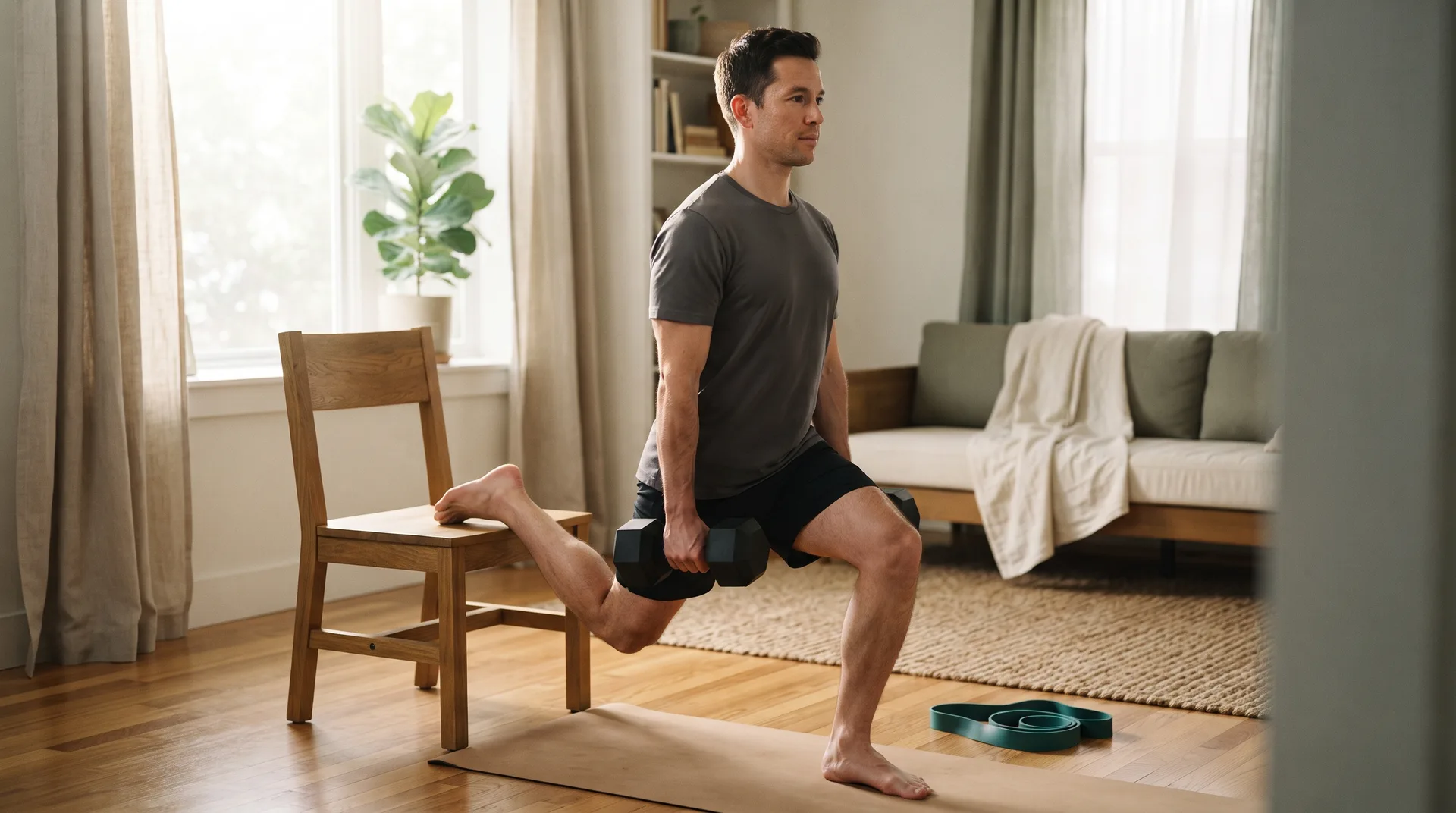
You don't need a gym to keep progressing once the beginner plans feel easy. A pair of dumbbells (ideally two weights), a couple of resistance bands, a chair and a floor are enough for a full-body plan. This one is for people who already train steadily and want to build strength and muscle at home. Each session takes about 40 to 50 minutes.
The plan in 30 seconds
- Train 3 days a week, full body, alternating two sessions (A and B).1,2
- Do 3 sets of 8 to 12 repetitions of each exercise, close to the point where more would be hard.3
- Progress in 4-week blocks with an easier week at the end of each block.4
- Aim for several hard sets per muscle each week. More weekly sets are associated with more muscle and strength.5,6
- Rest 1 to 2 minutes between most sets, a little longer on your heaviest ones.1,7
Who this plan is for
This plan is for people who have finished a beginner plan and have trained steadily for about 3 months or more, with solid technique on the basic movements. That is a coaching guideline: the American College of Sports Medicine uses about 6 months of consistent training as its label for an intermediate lifter.1 If you are newer than that, start with Beginner Full-Body Workout at Home: Bands and Dumbbells. You need dumbbells you can progress with, resistance bands, a sturdy chair or bench, and a mat.
Check with your doctor first if…
You have a medical condition (such as heart disease, high blood pressure, diabetes, osteoporosis or joint problems), are pregnant, take regular medication, or have been inactive for a long time. Also check first if you have chest pain or dizziness during activity. Most healthy adults don't need medical clearance to start. If you have a condition or symptoms, ask a health professional first.8
How often
Do the workout on 3 days a week, with a day off between sessions. For intermediate lifters, the ACSM recommends 3 to 4 days a week.1 Full-body sessions are a good fit at home: in a 12-week trial in untrained women, training the whole body 2 days a week gave similar results to an upper/lower split on 4 days when the weekly sets were equal.2 A review of studies also found no meaningful difference in muscle growth by training frequency when the weekly volume is the same.9 For example: Monday, Wednesday and Friday, alternating sessions A and B (A-B-A one week, B-A-B the next).
Warm up first (5 minutes)
The NIA's advice is to warm up for strength exercises by doing the exercise with less weight.3 Even experienced lifters start this way: many begin with an empty bar or a very light weight, practicing the movement and doing mobility work before they add load. This is common coaching practice, not a finding of the studies cited here. One way to do it:
- March in place or skip rope gently for 2 minutes.
- Make slow circles with your arms, hips and ankles.
- Do one light set of 6 to 8 repetitions of the first two exercises.
The warm-up above is an example from the editorial team, not a protocol taken from a study.
The workout
Each session has six exercises that cover your legs, hips, back, chest, shoulders and abdomen.10
Session A
| # | Exercise | Mainly works | What to do |
|---|---|---|---|
| 1 | Rear-foot-elevated split squat | Legs and hips | Stand a stride in front of a chair, with the top of your back foot resting on it. Hold a dumbbell in each hand. Lower your back knee toward the floor, then stand up. Do all repetitions on one leg, then switch. |
| 2 | Dumbbell Romanian deadlift | Back of the legs, hips | Hold the dumbbells in front of your thighs. Push your hips back with a flat back and soft knees until you feel a stretch behind your legs, then stand tall. |
| 3 | Push-up | Chest, shoulders, arms | Hands under your shoulders, body in a straight line. Lower your chest, then press back up. When 12 is easy, put your feet on a step. |
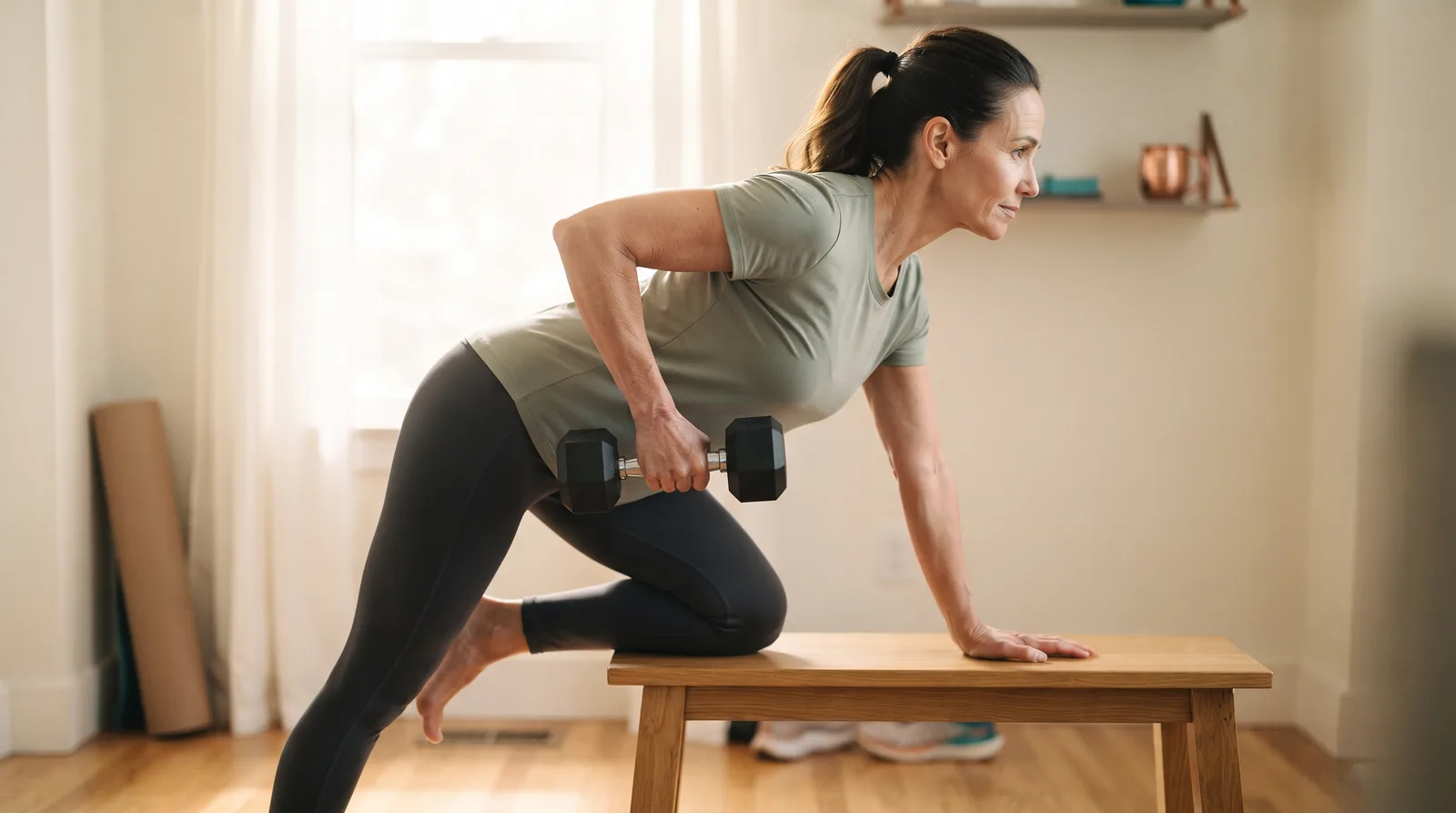
| 4 | One-arm dumbbell row | Upper back, arms | Rest one hand and knee on a chair or bench. Pull the dumbbell toward your hip, then lower it slowly. Switch sides. |
| 5 | Standing dumbbell overhead press | Shoulders, arms | Hold the dumbbells at shoulder height. Press them overhead without arching your back, then lower slowly. |
| 6 | Side plank | Sides of the abdomen | On one forearm, body in a straight line (knees down if needed). Hold for a few breaths, then switch sides. |
Session B
| # | Exercise | Mainly works | What to do |
|---|---|---|---|
| 1 | Goblet squat | Legs and hips | Hold one dumbbell upright at your chest. Sit down and back, then stand up. Use the heaviest dumbbell you can control. |
| 2 | Dumbbell hip thrust | Hips and back of the legs | Rest your upper back on a couch or bench with a dumbbell across your hips. Drive your hips up until your body is level, then lower. |
| 3 | Dumbbell floor press | Chest, shoulders, arms | Lie on your back, knees bent. Press the dumbbells up over your chest, then lower until your upper arms touch the floor. |
| 4 | Bent-over dumbbell row | Upper back, arms | Hinge forward with a flat back and pull both dumbbells toward your waist, then lower slowly. |
| 5 | Band pull-apart | Back of the shoulders, upper back | Hold a band in front of you at chest height, arms straight. Pull your hands apart until the band touches your chest, then return slowly. |
| 6 | Bird dog with a pause | Back, hips and abdomen | On hands and knees, reach one arm forward and the opposite leg back. Pause for two seconds, return and switch sides. |
The exercise list and layout are an example built from the guidance cited below. They are not a personal prescription.
Choosing the weight. Pick a weight that makes the last repetitions of each set hard, with good form.3 Research suggests that heavier loads (above about 80% of your one-rep max) maximize strength gains, while lighter and heavier loads can build a similar amount of muscle when sets are taken close to the limit.11,12 With dumbbells you may run out of weight. In that case, make an exercise harder instead: go slower, pause at the bottom, use one leg or one arm, or raise your feet. We don't give exact weights because the right load depends on you.
How many sets, reps and rest
Do 3 sets of 8 to 12 repetitions per exercise, to the point where one more repetition would be hard.3 The ACSM describes loads from 1 to 12 repetition maximum for intermediate lifters, varied over time.1 With 3 sessions a week, each muscle gets roughly 6 to 9 hard sets per week. That is above the minimum of about 4 weekly sets per muscle that a review of time-efficient training suggests,13 and, in a meta-regression, more weekly sets were associated with more muscle growth.5
Rest 1 to 2 minutes between most sets, and up to about 3 minutes on your heaviest sets. The ACSM suggests longer rests for heavy loading than for hypertrophy-focused training.1 A review of 9 studies found no appreciable difference in muscle growth for rests beyond 90 seconds.7 Whatever the clock says, wait until you have caught your breath and your breathing feels steady before you start the next set.
Your 8-week plan
| Weeks | Sets × reps | What to change |
|---|---|---|
| 1–3 | 3 × 10–12 | When you get 12 reps on all sets, add weight or make the exercise harder |
| 4 | 2 × 10 | Easier week: same weights, fewer sets |
| 5–7 | 3 × 8–10 | Use heavier weights or harder variations |
| 8 | 2 × 8 | Easier week: same weights, fewer sets |
Plans that vary the load over time (periodization) improved maximal strength more than plans that did not, in a meta-analysis of 18 studies.4 The exact weekly pattern above is an example. The ACSM suggests increasing the load by 2% to 10% once you can do one or two repetitions more than your target.1 Coaches who work with strength and physique athletes define a deload as a period of reduced training stress,14 but we found no randomized trial showing that an easier week improves later results. Scheduling the easier week every fourth week is a coaching convention.
Which variable to change depends on your goal. For strength, add weight: heavier loads maximize strength gains.11 For muscle size, you can add repetitions or sets: muscle growth is similar across loads when sets are close to the limit,12 and more weekly sets were associated with more growth.5 If you add repetitions, keep the sets the same; if you add a set, the repetitions can stay the same. People with a lot of training experience can raise two at once, for example weight and sets. How to combine them is a coaching guideline.
Cool down with an easy stretch
The NIA says to stretch when your muscles are warm, such as after strength exercises, to breathe while you do it, and to not stretch so far that it hurts.3 A few easy stretches for the muscles you just used are a good way to finish. The choice of stretches is an example from the editorial team.
Do you need pyramids, drop sets or training to failure?
No, though each can add variety.
- Variety. When total work is equal, plans that vary the load over time improved maximal strength more than plans that do not, but not muscle size.15 In that review, undulating ("wave") plans beat linear plans for strength, with a clear advantage in trained people and none in untrained people.15 Another review of 17 studies found no difference between the two.16 Changing exercises can also keep you motivated: in a trial of 21 trained men, varying the exercises every session gave the same strength and muscle gains as keeping them fixed, with better motivation.17
- Pyramids and drop sets. In 32 well-trained men followed for 12 weeks, a pyramid or a drop-set system did not beat traditional sets when total work was equal.18 A trial of rest-pause and drop sets found similar results.19 Use them for variety or to save time, not because they are better.
- Training to failure. A meta-analysis of 15 studies, mostly in young adults, found no difference in strength or muscle size between training to failure and stopping short, and concluded that failure is not required and does not appear harmful.20 Another review found no evidence that reaching momentary failure is better for muscle size.21 A good habit is to leave 1 to 3 repetitions in reserve on most sets, and to go closer to your limit on safe exercises.
These points summarize the abstracts of the studies cited. The "1 to 3 repetitions in reserve" habit is a coaching guideline.
Stay safe
- Listen to your body. Overdoing it can cause exhaustion, sore joints and muscle pain or injury.3
- Breathe out during the effort and in as you relax. Don't hold your breath.3
- Don't lock your joints straight in your arms and legs.3
- Check your chair or bench is stable before you put weight or your foot on it, and keep a clear space around you for the lunges and rows.
- Ask for help if you're unsure. A doctor or physical therapist can answer questions about a movement. A session or two with a personal trainer can teach you good form.3
Why this plan works
- It follows the U.S. baseline of strength activities on at least 2 days a week for all major muscle groups,10 and trains each muscle several times a week.
- It uses 3 sessions a week, in line with what the ACSM describes for intermediate lifters.1
- It uses full-body sessions, which gave similar results to splits when weekly sets were equal.2,9
- It varies the load over 4-week blocks, as periodized plans do.4
- It prioritizes multi-joint exercises (squat, hinge, push, pull) and keeps weekly sets above the minimum suggested for time-efficient training.13
Quick questions
Can I build muscle with only dumbbells?
Research on loads says muscle growth can be similar across a wide range of loads when sets are taken close to the limit,11,12 so lighter dumbbells can work if you make the sets hard enough. For maximal strength, heavier loads are better.11
Should I do an upper/lower split instead?
You can. With equal weekly sets, full-body and split plans gave similar results in trials.2 Pick the one you will actually follow.
What if I miss a session?
Pick up with the next session in the A/B order. Consistency matters more than catching up.
What should I do after week 8?
Don't repeat the same plan for months. Keep the structure, but change something every 4 to 8 weeks: swap exercises for variations (for example, the split squat for a step-up, the Romanian deadlift for a single-leg version, the floor push-up for a feet-elevated one), add a set or use a little more weight. Plans that varied the load over time improved maximal strength more than plans that did not, in a meta-analysis of 18 studies.4 The 4-to-8-week rule and the example swaps are coaching guidelines, not findings of the study.
When should I move up to the gym plan?
If you want heavier loads than you can get at home, try Intermediate Strength Workout at the Gym: 3-Day Full Body.
The bottom line
Train three days a week with two alternating full-body sessions. Do 3 sets of 8 to 12 repetitions, rest a minute or two, and build up over two 4-week blocks, each ending with an easier week. Make exercises harder when you run out of weight.

The images in this article were created with AI tools to illustrate concepts. They are not exact anatomical depictions or scientific evidence.
Be the first to like this
References
- American College of Sports Medicine. American College of Sports Medicine position stand. Progression models in resistance training for healthy adults. Med Sci Sports Exerc. 2009;41(3):687–708. doi:10.1249/MSS.0b013e3181915670
- Pedersen H, Fimland MS, Schoenfeld BJ, et al. A randomized trial on the efficacy of split-body versus full-body resistance training in non-resistance trained women. BMC Sports Sci Med Rehabil. 2022;14(1):87. doi:10.1186/s13102-022-00481-7
- National Institute on Aging (NIA), National Institutes of Health. Three Types of Exercise Can Improve Your Health and Physical Ability. Content reviewed January 14, 2025.
- Williams TD, Tolusso DV, Fedewa MV, Esco MR. Comparison of periodized and non-periodized resistance training on maximal strength: a meta-analysis. Sports Med. 2017;47(10):2083–2100. doi:10.1007/s40279-017-0734-y
- Schoenfeld BJ, Ogborn D, Krieger JW. Dose-response relationship between weekly resistance training volume and increases in muscle mass: a systematic review and meta-analysis. J Sports Sci. 2017;35(11):1073–1082. doi:10.1080/02640414.2016.1210197
- Ralston GW, Kilgore L, Wyatt FB, Baker JS. The effect of weekly set volume on strength gain: a meta-analysis. Sports Med. 2017;47(12):2585–2601. doi:10.1007/s40279-017-0762-7
- Singer A, Wolf M, Generoso L, et al. Give it a rest: a systematic review with Bayesian meta-analysis on the effect of inter-set rest interval duration on muscle hypertrophy. Front Sports Act Living. 2024;6:1429789. doi:10.3389/fspor.2024.1429789
- Piercy KL, Troiano RP, Ballard RM, et al. The Physical Activity Guidelines for Americans. JAMA. 2018;320(19):2020–2028. doi:10.1001/jama.2018.14854 (author manuscript: PMC9582631)
- Schoenfeld BJ, Grgic J, Krieger J. How many times per week should a muscle be trained to maximize muscle hypertrophy? A systematic review and meta-analysis of studies examining the effects of resistance training frequency. J Sports Sci. 2019;37(11):1286–1295. doi:10.1080/02640414.2018.1555906
- Centers for Disease Control and Prevention. Physical Activity Guidelines for Adults. Physical Activity Basics. Page dated December 20, 2023.
- Currier BS, Mcleod JC, Banfield L, et al. Resistance training prescription for muscle strength and hypertrophy in healthy adults: a systematic review and Bayesian network meta-analysis. Br J Sports Med. 2023;57(18):1211–1220. doi:10.1136/bjsports-2023-106807
- Lopez P, Radaelli R, Taaffe DR, et al. Resistance training load effects on muscle hypertrophy and strength gain: systematic review and network meta-analysis. Med Sci Sports Exerc. 2021;53(6):1206–1216. doi:10.1249/mss.0000000000002585
- Iversen VM, Norum M, Schoenfeld BJ, Fimland MS. No time to lift? Designing time-efficient training programs for strength and hypertrophy: a narrative review. Sports Med. 2021;51(10):2079–2095. doi:10.1007/s40279-021-01490-1
- Bell L, Strafford BW, Coleman M, Androulakis Korakakis P, Nolan D. Integrating deloading into strength and physique sports training programmes: an international Delphi consensus approach. Sports Med Open. 2023;9:87. doi:10.1186/s40798-023-00633-0
- Moesgaard L, Beck MM, Christiansen L, et al. Effects of periodization on strength and muscle hypertrophy in volume-equated resistance training programs: a systematic review and meta-analysis. Sports Med. 2022;52(7):1647–1666. doi:10.1007/s40279-021-01636-1
- Harries SK, Lubans DR, Callister R. Systematic review and meta-analysis of linear and undulating periodized resistance training programs on muscular strength. J Strength Cond Res. 2015;29(4):1113–1125. doi:10.1519/jsc.0000000000000712
- Baz-Valle E, Schoenfeld BJ, Torres-Unda J, et al. The effects of exercise variation in muscle thickness, maximal strength and motivation in resistance trained men. PLoS One. 2019;14(12):e0226989. doi:10.1371/journal.pone.0226989
- Angleri V, Ugrinowitsch C, Libardi CA. Crescent pyramid and drop-set systems do not promote greater strength gains, muscle hypertrophy, and changes on muscle architecture compared with traditional resistance training in well-trained men. Eur J Appl Physiol. 2017;117(2):359–369. doi:10.1007/s00421-016-3529-1
- Enes A, Alves RC, Schoenfeld BJ, et al. Rest-pause and drop-set training elicit similar strength and hypertrophy adaptations compared with traditional sets in resistance-trained males. Appl Physiol Nutr Metab. 2021;46(11):1417–1424. doi:10.1139/apnm-2021-0278
- Grgic J, Schoenfeld BJ, Orazem J, Sabol F. Effects of resistance training performed to repetition failure or non-failure on muscular strength and hypertrophy: a systematic review and meta-analysis. J Sport Health Sci. 2022. doi:10.1016/j.jshs.2021.01.007
- Refalo MC, Helms ER, Trexler ET, Hamilton DL, Fyfe JJ. Influence of resistance training proximity-to-failure on skeletal muscle hypertrophy: a systematic review with meta-analysis. Sports Med. 2023. doi:10.1007/s40279-022-01784-y
Related articles
Beginner Full-Body Workout at Home: Bands and Dumbbells
A simple full-body strength workout using resistance bands and a pair of dumbbells, 2 to 3 days a week, with a 12-week plan to build up slowly and safely.
Oct 19, 2026 · 11 min readRead →
Intermediate Strength Workout at the Gym: 3-Day Full Body
A 3-day full-body strength plan for people with some lifting experience, with an 8-week progression and sources for the sets, reps and rest.
Oct 19, 2026 · 11 min readRead →
Beginner Full-Body Workout at Home (No Equipment)
A simple full-body strength workout you can do at home with no equipment, 2 to 3 days a week, with a 12-week plan to build up slowly and safely.
Oct 19, 2026 · 10 min readRead →