Beginner Full-Body Workout at Home (No Equipment)
By Vital Muscles · 2026-10-19 · 10 min read
Sources checked by the Vital Muscles editorial team on 2026-10-19. How we check
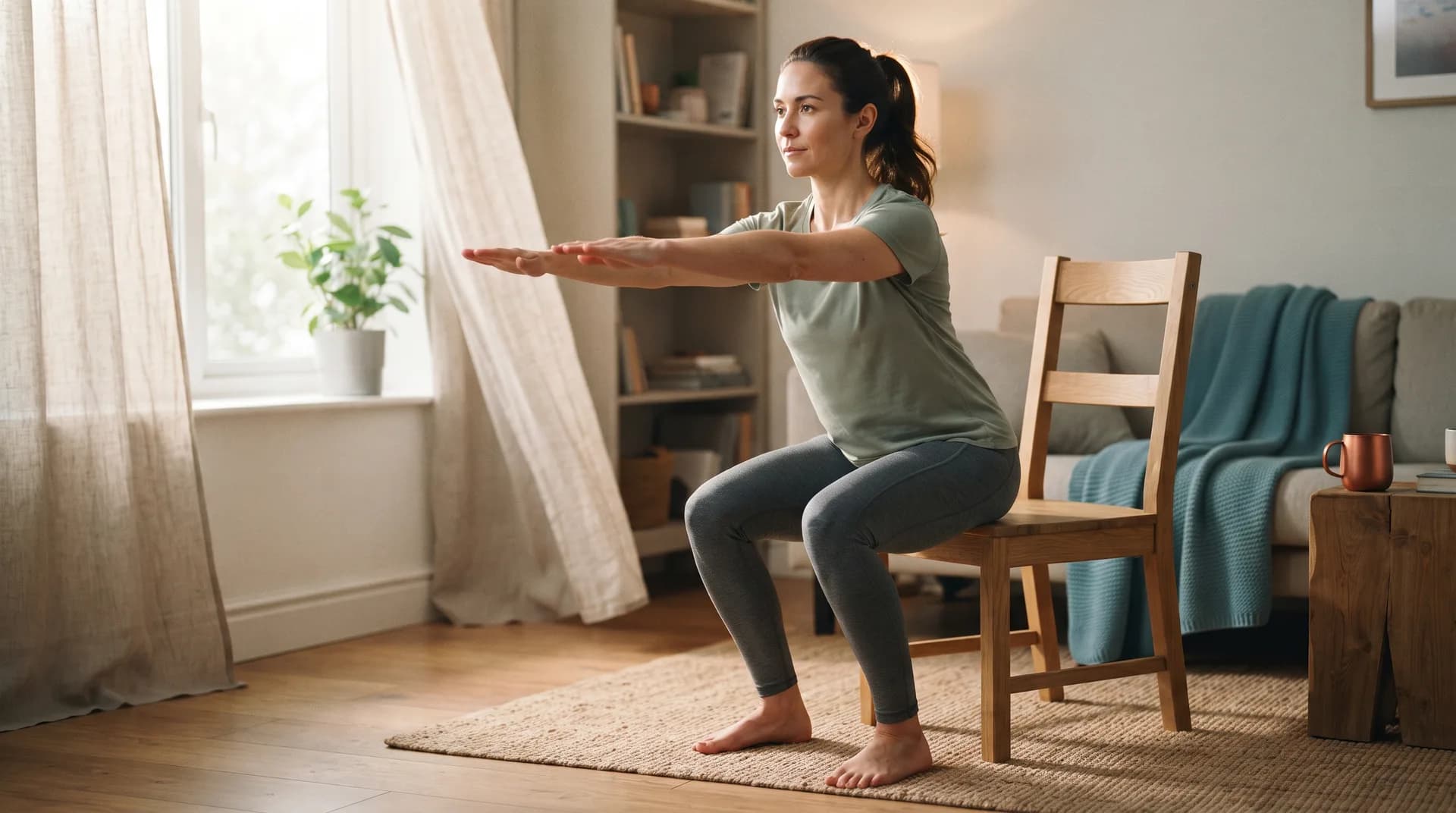
You don't need a gym or any equipment to start getting stronger. A chair, a wall and a bit of floor are enough. This plan is for people who are new to strength training, or coming back after a long break, and who want a simple routine they can do at home. It takes about 20 to 30 minutes.
The plan in 30 seconds
- Do it on 2 or 3 days a week, working all the big muscle groups, back included.1
- Do 8 to 12 repetitions of each exercise, to the point where one more would be hard.2
- Start with two sets of each (one if you have been very inactive), then build up to three.2
- Rest about 1 to 2 minutes between sets, and give the same muscles a day off between sessions.2,3
- Start low and go slow.4
Who this plan is for
It is written for beginners: people with no experience in strength training, or who haven't trained for several years.5 It uses only your body weight and a few things you already have at home, so it needs no equipment.
Check with your doctor first if…
You have a medical condition (such as heart disease, high blood pressure, diabetes, osteoporosis or joint problems), are pregnant, take regular medication, or have been inactive for a long time. Also check first if you have chest pain or dizziness during activity. Most healthy adults don't need medical clearance to start. If you have a condition or symptoms, ask a health professional first.4
How often
Do the workout on 2 or 3 days a week. Two days is the official minimum;1 three days a week is within what the American College of Sports Medicine recommends for people new to strength training.5 Leave a day between sessions so your muscles can recover.2 For example: Monday and Thursday, or Monday, Wednesday and Friday.
Warm up first (3 to 5 minutes)
The NIA's advice is to warm up for strength exercises by doing the exercise with less weight.2 For a body-weight routine, that means starting with easy versions. One way to do it:
- Walk or march in place for a minute or two.
- Make slow circles with your arms, hips and ankles.
- Do 5 or 6 very easy repetitions of the chair squat and the wall push-up.
The warm-up above is an example from the editorial team, not a protocol taken from a study.
The workout
Do the exercises in order. Each one works a different part of the body, which together cover your legs, hips, back, chest, shoulders, arms and abdomen.1
| # | Exercise | Mainly works | What to do |
|---|---|---|---|
| 1 | Chair squat (sit down and stand up) | Legs and hips | Stand in front of a sturdy chair. Sit down slowly, then stand up. Use your hands on your thighs if you need to. |
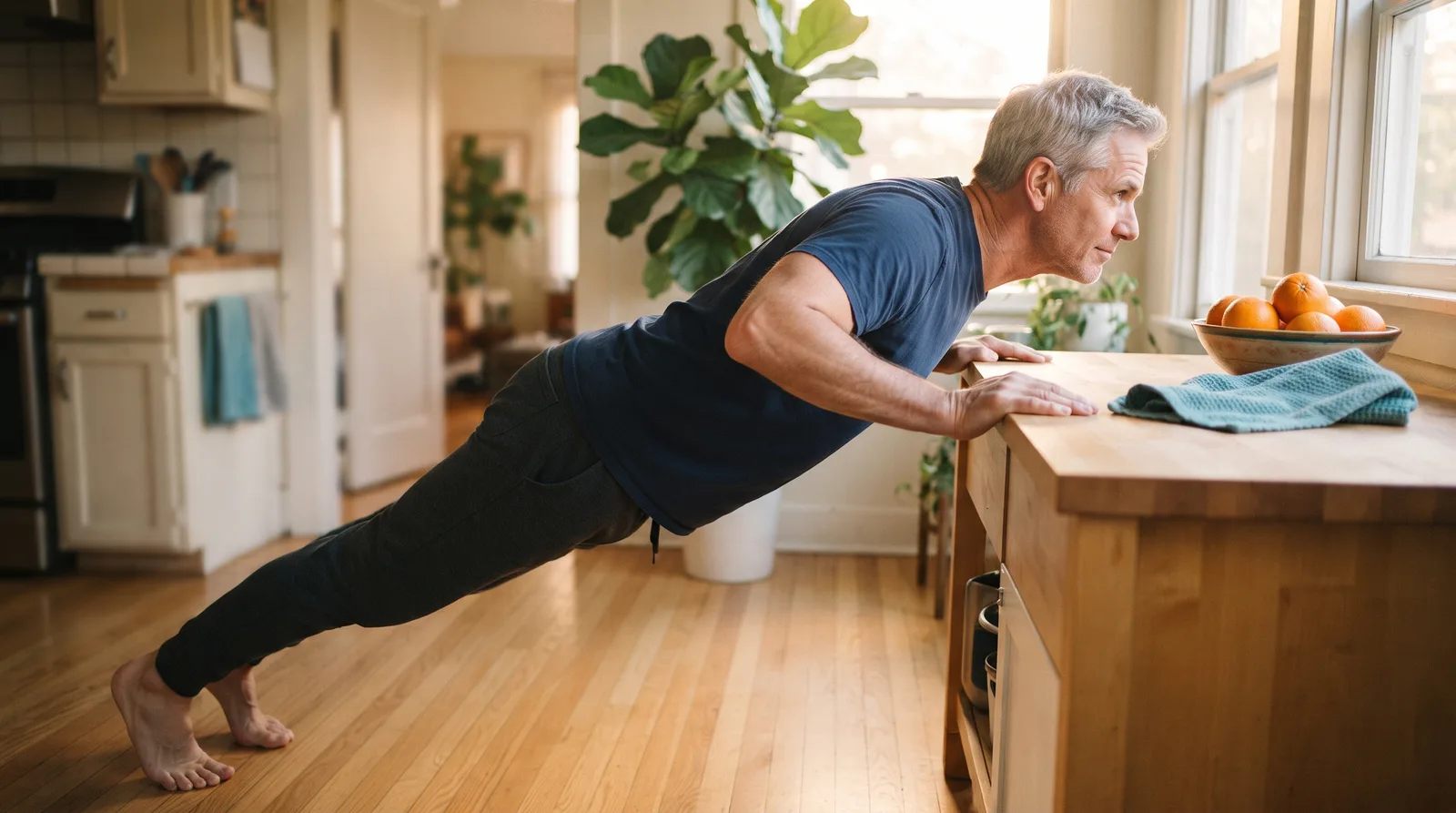
| 2 | Wall push-up | Chest, shoulders, arms | Stand facing a wall, hands on it at chest height. Bend your elbows to bring your chest toward the wall, then push back. |
| 3 | Glute bridge | Hips and back of the legs | Lie on your back, knees bent, feet flat. Push through your feet to lift your hips, then lower slowly. |
| 4 | Supported one-arm row | Upper back, arms | Hold a light backpack in one hand. Rest the other hand on a chair or table and lean forward with a flat back. Pull the bag toward your waist, then lower it. Switch sides. No bag? Lie face down and slowly lift your arms off the floor. |
| 5 | Bird dog | Back, hips and abdomen | On hands and knees, reach one arm forward and the opposite leg back. Hold briefly, return and switch sides. |
| 6 | Counter plank | Abdomen and shoulders | Put your hands on a sturdy counter or table, body in a straight line. Hold for a few seconds. |
The exercise list and layout are an example built from the guidance cited below. They are not a personal prescription.
How many sets and reps
Do 8 to 12 repetitions of each exercise (for the plank and bird dog, hold or alternate for the same count). That is one set.2 Stop each set when one more repetition would be hard, but keep good form.2 In the first month, while you learn the movements, it is fine to stop a couple of repetitions before your limit, so you finish a little tired but not exhausted. In a meta-analysis of 15 studies, mostly in young adults, training to failure was not needed to gain strength or muscle size.6 The first-month advice is a coaching guideline.
Prefer fewer repetitions? If 12 repetitions leave you too tired, you can use a slightly harder version of the exercise and do 6 to 8 repetitions instead, so you can still finish all your sets. A network meta-analysis found that heavier loads maximize strength gains and that muscle growth is similar across loads.7 Learn the technique with lighter loads first. Using 6 to 8 repetitions is a coaching option for beginners; the guidelines we cite describe 8 to 12 repetitions.
Rest about 1 to 2 minutes between sets. A review of 23 studies (491 people) found that people new to training seem to gain strength best with rests of about 60 to 120 seconds. Solid gains were possible even with rests under 60 seconds.3 A separate review of 9 studies on muscle size found a small benefit from resting longer than 60 seconds, with no appreciable difference beyond 90 seconds.8 Whatever the clock says, wait until you have caught your breath and your breathing feels steady before you start the next set.
Your 12-week plan
| Weeks | Sets of each exercise | Make it a bit harder |
|---|---|---|
| 1–4 (month 1) | 2 sets (1 set if you have been very inactive) | Learn the movements and keep the effort moderate |
| 5–8 (month 2) | 3 sets of 8 to 10 repetitions | Use a slightly harder version of each exercise as it gets easier |
| 9–12 (month 3) | 3 sets of 8 to 10 repetitions | Move to a harder version of one or two exercises (see below) |
The NIA says one set of 8 to 12 repetitions is effective, and that two or three sets may be more effective.2 This plan starts at two sets, because many people who are active in daily life can do them. If you have been very inactive, or two sets feels like too much, start with one and add the second when it feels easy. Starting at two sets is a coaching choice, not a rule from the guidelines. Build up in small steps.4 The ACSM adds that once you can do one or two repetitions more than your target, it is time to make the exercise a little harder. With weights, that means 2% to 10% more.5
How long does the beginner stage last? In our coaching experience, a healthy beginner without medical limitations spends the first month learning the movements, builds up in the second month with a little more weight, and is often ready for an intermediate plan after about three months of steady training. This timeline is a coaching guideline, not a rule from the studies cited here. If you have a medical condition, follow the plan your health professional approves.
Change one thing at a time. To make a plan harder you can add repetitions, add a set, or add weight. At the beginner stage, change only one of them at a time: if you add repetitions, keep the sets the same; if you add a set, keep the repetitions the same. Which one you choose depends on your goal: weight for strength, and more sets or repetitions for size. People with a lot of training experience can change two at once. This is a coaching guideline.
How to make it harder
When 12 repetitions start to feel easy, change the exercise instead of adding weight:
| Exercise | Step 1 | Step 2 | Step 3 |
|---|---|---|---|
| Chair squat | Squat to a lower seat or a cushion | Squat without sitting | Split squat (one foot forward) |
| Wall push-up | Counter push-up | Knee push-up | Full push-up |
| Glute bridge | Hold the top for a moment | Single-leg bridge | — |
| Supported row | A heavier bag | Slower lowering of the bag | — |
In small trials in young men, progressive push-up training improved upper-body strength.9 Push-ups in an easier position (such as on the knees) built strength and muscle in a similar way to a bench press at a matched load.10
Cool down with an easy stretch
The NIA says to stretch when your muscles are warm, such as after strength exercises, to breathe while you do it, and to not stretch so far that it hurts.2 A few easy stretches for the muscles you just used, such as the front of the thighs, the chest and the upper back, are a good way to finish. The choice of stretches is an example from the editorial team.
Stay safe
- Listen to your body. Overdoing it can cause exhaustion, sore joints and muscle pain or injury.2
- Breathe out during the effort and in as you relax. Don't hold your breath.2
- Don't lock your joints straight in your arms and legs.2
- Ask for help if you're unsure. A doctor or physical therapist can answer questions about a movement. A session or two with a personal trainer can teach you good form.2
Why this plan works
- It follows the U.S. baseline of strength activities on at least 2 days a week for all major muscle groups, including the back.1,2
- It uses the repetitions and sets that the NIA and the CDC describe as effective for strength: 8 to 12 repetitions, to the point where another would be difficult.2
- Body-weight exercises count: the NIA lists squats, push-ups and planks among strengthening exercises,2 and in studies, progressive push-up variations improved upper-body strength.9,10
- It builds up gradually, in line with the "start low and go slow" advice for people who have been inactive.4
- Training at home can work, but the evidence we found is in older adults. A review of 21 randomized trials (4,053 adults aged 60 and over) found no major adverse events with unsupervised home-based resistance training. It modestly improved lower-body strength and power. People did, on average, only about two-thirds of the planned sessions.11 Keep the plan simple enough to stick to.
Quick questions
Do I need weights?
No. Your own body weight is enough to start, and you can progress with harder variations.2,9
Can I do this every day?
Give the same muscles a day off between sessions. The NIA advises avoiding working the same muscle group on two days in a row.2
How long should I rest between sets?
About 1 to 2 minutes is a sensible range for beginners.3,8 Whatever the clock says, make sure you have caught your breath: wait until your breathing feels steady again before you start the next set.
How long can I keep doing the same plan?
Not for many months. Your body adapts to a routine, and a plan that never changes eventually stops being a challenge. In a meta-analysis of 18 studies, plans that varied the load over time improved maximal strength more than plans that did not.12 In our coaching experience, it helps to change something about once a month, such as a harder variation, a little more weight or one more set. This plan builds that in: month 1 is adaptation, month 2 adds sets and weight, and month 3 moves to harder variations before you step up to the next plan. The change-every-month rule is a coaching guideline, not a finding of the study.
When should I move up to a harder plan?
When you can do the whole workout comfortably with good technique, usually after about 3 months of steady training, try Intermediate Full-Body Workout at Home: Dumbbells and Bands. If you would rather train at a gym, see Beginner Full-Body Workout at the Gym: Machines. If you have resistance bands and a pair of dumbbells, try Beginner Full-Body Workout at Home with Bands and Dumbbells. For the basics in more detail, read How to Start Strength Training: A Simple Beginner's Guide. This timeline is a coaching guideline. The ACSM's label for an intermediate lifter is about 6 months of consistent training.5
The bottom line
Two or three days a week, six simple exercises, 8 to 12 repetitions each, a minute or two of rest between sets, and a slow build-up over about three months. That's enough to begin.

The images in this article were created with AI tools to illustrate concepts. They are not exact anatomical depictions or scientific evidence.
Be the first to like this
References
- Centers for Disease Control and Prevention. Physical Activity Guidelines for Adults. Physical Activity Basics. Page dated December 20, 2023.
- National Institute on Aging (NIA), National Institutes of Health. Three Types of Exercise Can Improve Your Health and Physical Ability. Content reviewed January 14, 2025.
- Grgic J, Schoenfeld BJ, Skrepnik M, Davies TB, Mikulic P. Effects of rest interval duration in resistance training on measures of muscular strength: a systematic review. Sports Med. 2018;48(1):137–151. doi:10.1007/s40279-017-0788-x
- Piercy KL, Troiano RP, Ballard RM, et al. The Physical Activity Guidelines for Americans. JAMA. 2018;320(19):2020–2028. doi:10.1001/jama.2018.14854 (author manuscript: PMC9582631)
- American College of Sports Medicine. American College of Sports Medicine position stand. Progression models in resistance training for healthy adults. Med Sci Sports Exerc. 2009;41(3):687–708. doi:10.1249/MSS.0b013e3181915670
- Grgic J, Schoenfeld BJ, Orazem J, Sabol F. Effects of resistance training performed to repetition failure or non-failure on muscular strength and hypertrophy: a systematic review and meta-analysis. J Sport Health Sci. 2022. doi:10.1016/j.jshs.2021.01.007
- Currier BS, Mcleod JC, Banfield L, et al. Resistance training prescription for muscle strength and hypertrophy in healthy adults: a systematic review and Bayesian network meta-analysis. Br J Sports Med. 2023;57(18):1211–1220. doi:10.1136/bjsports-2023-106807
- Singer A, Wolf M, Generoso L, et al. Give it a rest: a systematic review with Bayesian meta-analysis on the effect of inter-set rest interval duration on muscle hypertrophy. Front Sports Act Living. 2024;6:1429789. doi:10.3389/fspor.2024.1429789
- Kotarsky CJ, Christensen BK, Miller JS, Hackney KJ. Effect of progressive calisthenic push-up training on muscle strength and thickness. J Strength Cond Res. 2018;32(3):651–659. doi:10.1519/JSC.0000000000002345
- Kikuchi N, Nakazato K. Low-load bench press and push-up induce similar muscle hypertrophy and strength gain. J Exerc Sci Fit. 2017;15(1):37–42. doi:10.1016/j.jesf.2017.06.003
- Mañas A, Gómez-Redondo P, Valenzuela PL, Morales JS, Lucía A, Ara I. Unsupervised home-based resistance training for community-dwelling older adults: a systematic review and meta-analysis of randomized controlled trials. Ageing Res Rev. 2021;69:101368. doi:10.1016/j.arr.2021.101368
- Williams TD, Tolusso DV, Fedewa MV, Esco MR. Comparison of periodized and non-periodized resistance training on maximal strength: a meta-analysis. Sports Med. 2017;47(10):2083–2100. doi:10.1007/s40279-017-0734-y
Related articles
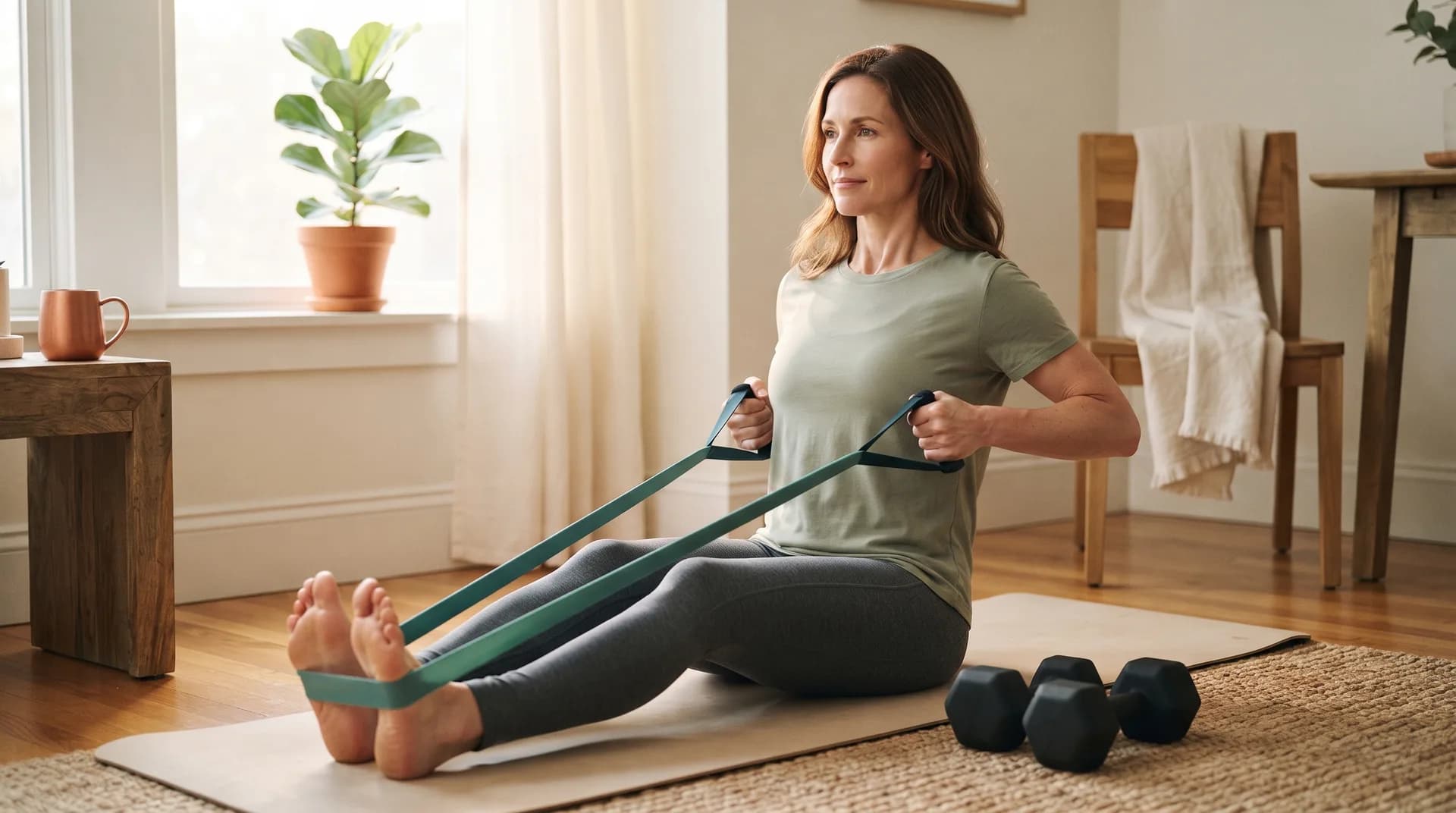
Beginner Full-Body Workout at Home: Bands and Dumbbells
A simple full-body strength workout using resistance bands and a pair of dumbbells, 2 to 3 days a week, with a 12-week plan to build up slowly and safely.
Oct 19, 2026 · 11 min readRead →
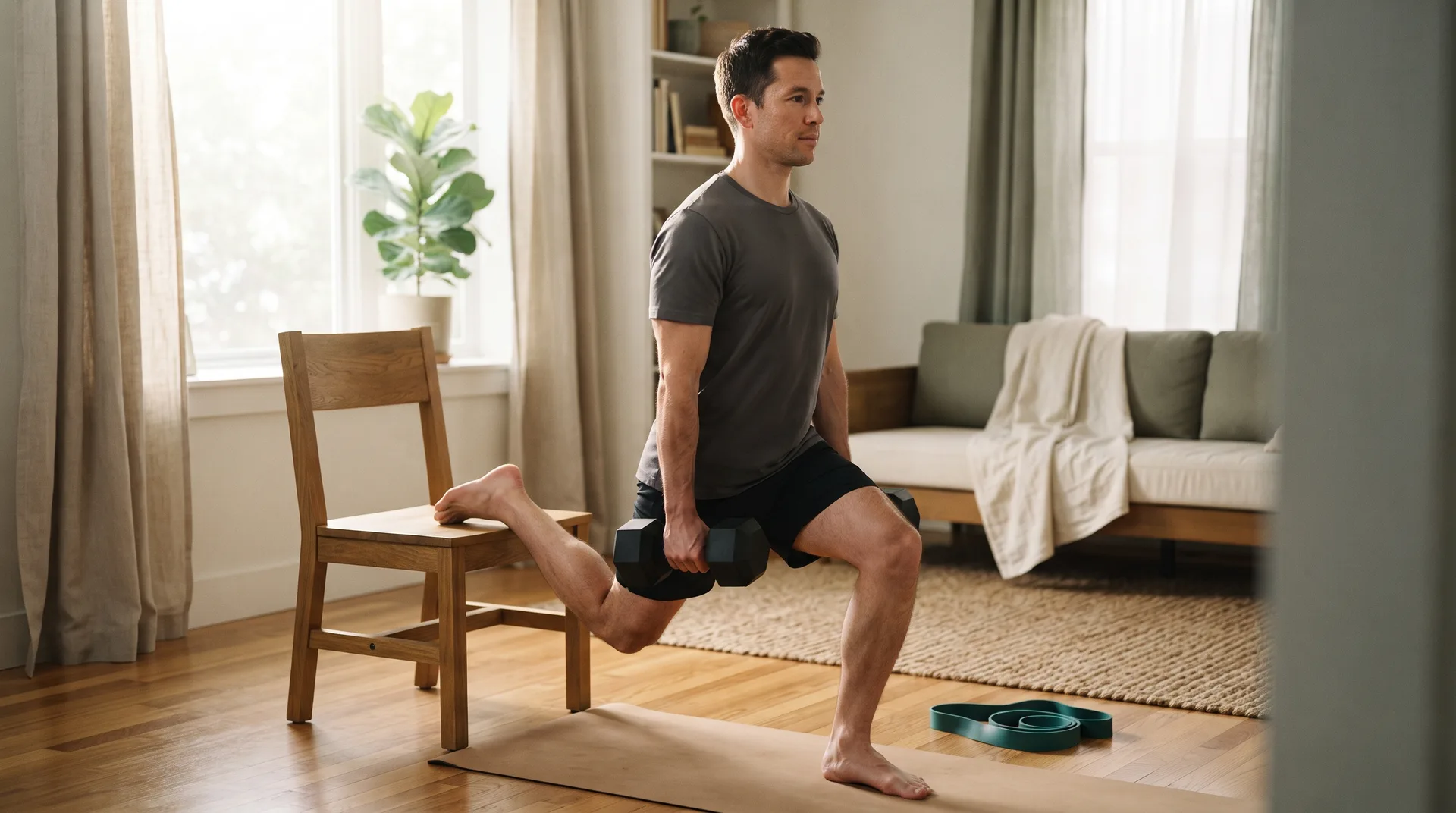
Intermediate Full-Body Workout at Home: Dumbbells and Bands
A 3-day full-body strength plan for people with some training experience, using dumbbells, bands and a chair, with an 8-week progression.
Oct 19, 2026 · 11 min readRead →
Beginner Full-Body Workout at the Gym: Machines
A simple full-body strength workout on gym machines, 2 to 3 days a week, with a 12-week plan to build up slowly and safely.
Oct 19, 2026 · 9 min readRead →