How Much Exercise Do Adults Need Each Week?
By Vital Muscles · 2026-10-27 · 5 min read
Sources checked by the Vital Muscles editorial team on 2026-10-28. How we check
This is the detailed version, with numbers and study details. Prefer the plain-language overview? Read the simple guide: How Much Exercise Do You Need? A Simple Guide

Ask five people how much exercise adults need and you may get five different answers. The U.S. guidelines are more specific than most people expect — and more flexible.
Key takeaways
- Adults need 150–300 minutes a week of moderate-intensity aerobic activity, or 75–150 minutes of vigorous activity, or an equivalent mix — plus muscle-strengthening activity on at least 2 days.1,2
- Adults 65 and older follow the same amounts and add activities that improve balance.3
- Any amount is better than none, and shorter bouts count toward your total.1,2
The short answer
| What | How much |
|---|---|
| Moderate-intensity aerobic activity | 150–300 minutes a week1,2 |
| …or vigorous-intensity aerobic activity | 75–150 minutes a week2 |
| …or an equivalent mix of the two | Counts toward the same goal2 |
| Muscle-strengthening activity | At least 2 days a week, working all major muscle groups2,4 |
| Adults 65 and older | The same, plus activities that improve balance3 |
The CDC's adult recommendation is at least 150 minutes of moderate activity or 75 minutes of vigorous activity a week.4 The full U.S. guidelines say adults need 150 to 300 minutes of moderate-intensity activity a week, plus muscle-strengthening, to get the most health benefits.1 Because 75 minutes of vigorous activity is treated as equal to 150 minutes of moderate activity, one vigorous minute counts about the same as two moderate minutes.
What counts as moderate or vigorous?
A simple rule from the CDC is the talk test. During moderate-intensity activity you can talk but not sing. During vigorous-intensity activity you can't say more than a few words without pausing to breathe.5 On a 0–10 effort scale, about 5–6 is moderate and 7–8 is vigorous.5
| Moderate intensity | Vigorous intensity |
|---|---|
| Brisk walking (2.5 mph or faster) | Jogging or running |
| Recreational swimming | Lap swimming |
| Bicycling slower than 10 mph on level ground | Bicycling faster than 10 mph |
| Doubles tennis | Singles tennis |
| Active yoga (such as Vinyasa or power yoga) | Vigorous dancing |
| Ballroom or line dancing | Jumping rope |
| General yard work and home repair | Heavy yard work, such as digging or shoveling |
| Water aerobics | Vigorous step aerobics or kickboxing |
Examples from the CDC.5

How to fit it into your week
You don't have to do it all at once. The CDC gives one example of how to reach 150 minutes: 30 minutes a day on 5 days.4 The second edition of the U.S. guidelines also dropped the old requirement that activity be done in bouts of at least 10 minutes, so shorter bouts spread through the day count.1
Using the two-to-one rule, a mix works too. For example, 60 minutes of brisk walking plus 45 minutes of jogging adds up to the equivalent of 150 moderate minutes.
Muscle-strengthening: what and how often
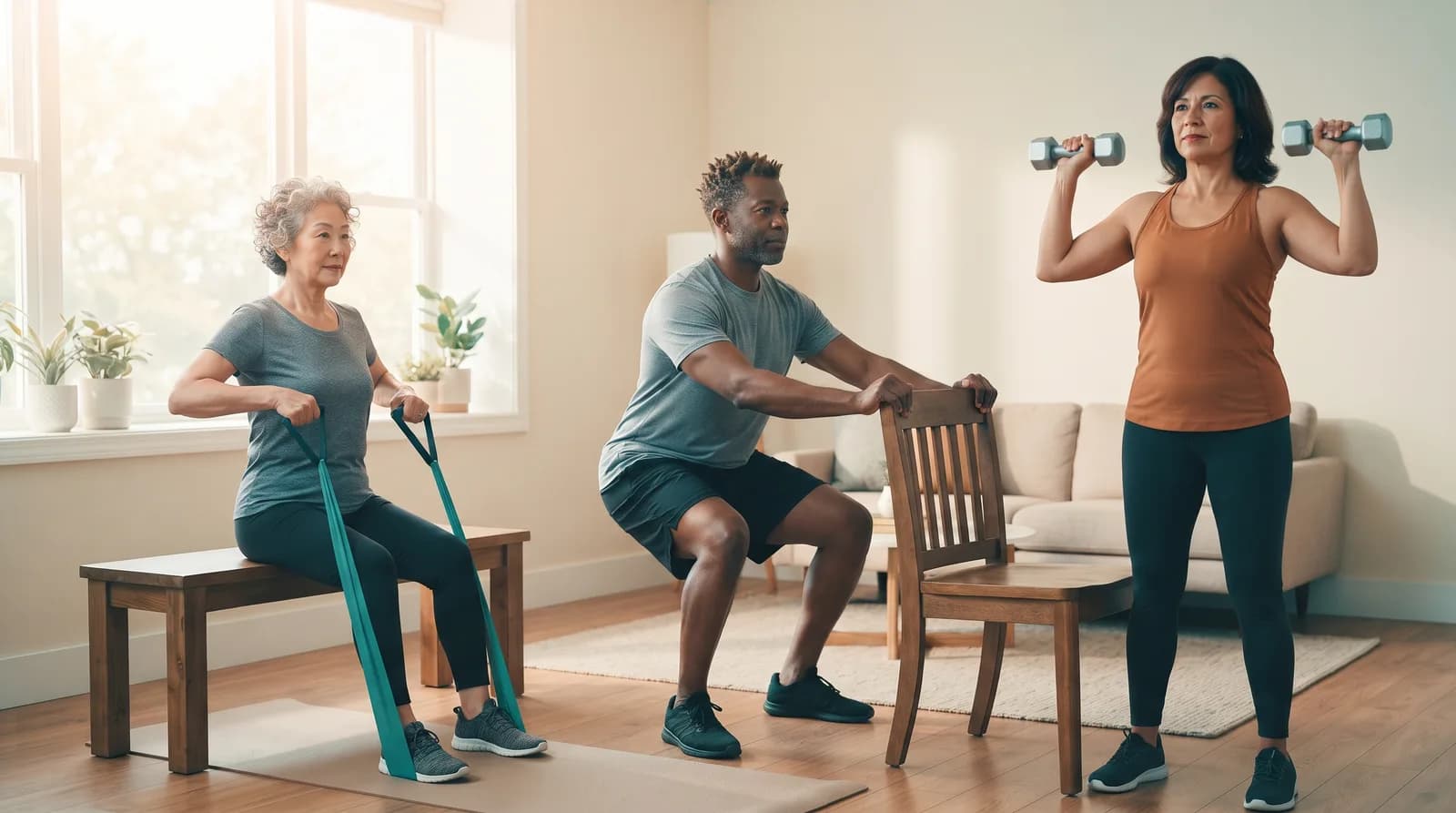
Muscle-strengthening is its own recommendation, in addition to aerobic activity.2 The guidelines call for activities that work all of the major muscle groups — legs, hips, back, abdomen, chest, shoulders and arms — on at least 2 days a week.4 Walking counts toward your aerobic minutes, not toward your strength days.
Why muscle matters so much is the subject of Muscle Is an Organ: What It Needs to Survive, and what happens when it declines is explained in What Is Sarcopenia?.
If you are 65 or older
The CDC recommends the same weekly amounts for adults 65 and older — at least 150 minutes of moderate activity, or 75 minutes of vigorous activity, or an equivalent mix — plus muscle-strengthening on at least 2 days a week and activities that improve balance.3 If you have trouble reaching these amounts, the CDC advises being as physically active as your abilities and health conditions allow.3
If you can't reach the numbers yet
Some physical activity is better than none, and health benefits increase as activity increases.3 According to the U.S. guidelines, people who are least active gain the most from even modest increases.2
Check with your doctor first if…
You have a medical condition (such as heart disease, diabetes or kidney disease), are pregnant, take regular medication, have chest pain or dizziness during activity, or have been inactive for a long time. A doctor or other qualified professional can help you choose a safe starting point.
Frequently asked questions
Do I need the full 300 minutes?
No. The guidelines give a range. The CDC's adult recommendation is at least 150 minutes a week of moderate activity, and the U.S. guidelines say 150 to 300 minutes is what adults need to get the most health benefits.1,4 More activity brings additional benefits.3
Does walking count?
Brisk walking (2.5 mph or faster) counts as moderate-intensity aerobic activity.5 It does not count toward the muscle-strengthening recommendation.2
Does housework or yard work count?
General yard work and home repair count as moderate-intensity activity, and heavy yard work such as digging or shoveling counts as vigorous.5
Are these guidelines only for the United States?
The World Health Organization's 2020 guidelines give the same aerobic ranges — 150–300 minutes of moderate or 75–150 minutes of vigorous activity a week — and recommend regular muscle-strengthening activity.6
The bottom line
Aim for 150–300 minutes of moderate activity (or 75–150 minutes of vigorous activity) a week, add muscle-strengthening on at least 2 days, and, if you are 65 or older, add balance work. If that sounds like a lot, start with what you can do: any amount counts.

The images in this article were created with AI tools to illustrate concepts. They are not exact anatomical depictions or scientific evidence.
Be the first to like this
References
- Office of Disease Prevention and Health Promotion (ODPHP), U.S. Department of Health and Human Services. Top 10 Things to Know About the Second Edition of the Physical Activity Guidelines for Americans. Content last updated November 19, 2025.
- Piercy KL, Troiano RP, Ballard RM, et al. The Physical Activity Guidelines for Americans. JAMA. 2018;320(19):2020–2028. doi:10.1001/jama.2018.14854
- Centers for Disease Control and Prevention. Physical Activity Guidelines for Older Adults (65 and older). Physical Activity Basics. Page dated December 4, 2025.
- Centers for Disease Control and Prevention. Physical Activity Guidelines for Adults. Physical Activity Basics. Page dated December 20, 2023.
- Centers for Disease Control and Prevention. Measuring Physical Activity Intensity. Physical Activity Basics. Page dated December 4, 2025.
- Bull FC, Al-Ansari SS, Biddle S, et al. World Health Organization 2020 guidelines on physical activity and sedentary behaviour. Br J Sports Med. 2020;54(24):1451–1462. doi:10.1136/bjsports-2020-102955
Related articles

Why Exercise Matters: What the Evidence Says
Regular exercise lowers the risk of heart disease, diabetes and some cancers and helps mood and sleep. Here is what U.S. guidelines and research say.
Oct 16, 2026 · 6 min readRead →

How to Start Strength Training: A Simple Beginner's Guide
New to strength training? A plain-language guide to how often, how many reps and how to start safely, using simple exercises at home.
Oct 22, 2026 · 3 min readRead →